Medicare 101
Whether you're retiring soon or already on Medicare, we’ve broken down what Medicare coverage looks like, how it works and how to sign up.
Preparing for Medicare? Here’s what you need to know
As a member, you can take your coverage into retirement with you. You must have at least five years of consecutive enrollment in the Federal Employees Health Benefits (FEHB) Program and/or Postal Service Health Benefits (PSHB) Program immediately before you retire to keep your coverage as a retiree.
If you are a Postal employee, you are also required to enroll in Medicare Parts A and B when you're first eligible. You must also enroll in the FEP Medicare Prescription Drug Program (MPDP) to have prescription drug coverage through FEP.

Whether you’re approaching retirement or Medicare, we’ll help you understand your options with FEP.
As you approach retirement
For most people, you can sign up for Medicare starting three months before you turn 65 and ending three months after your 65th birthday.
To keep BCBS FEP coverage after you retire, you generally need to have been enrolled in an FEHB or PSHB plan for the five years right before retirement. You don’t have to be enrolled in FEP for all five years. You can have coverage through another FEHB or PSHB insurance carrier and switch to FEP during Open Season after you retire.
Check out the costs of care and prescription drugs with and without FEP plus Medicare to understand how FEP can help you save and access more through retirement.
Approaching or eligible for Medicare
Compare your FEP health plan with Medicare plus your FEP health plan at least 6 months before retiring
Understand when you can delay Medicare enrollment or when penalties may apply
See what savings look like with different plans to find the best fit for you
Get started with Medicare
The Parts of Medicare
Medicare has four parts you can enroll in. Parts A and B make up Original Medicare. Here’s what they are and what’s covered.
What you pay for Original Medicare (Parts A & B)
Part A out-of-pocket costs
For inpatient hospital care, you have a deductible to meet before Medicare will begin paying for its portion of the services. The deductible in 2026 is $1,736 per benefit period per person. You’ll also have copays for inpatient care under Part A.
Lifetime Reserve Days
Medicare covers up to 90 days of inpatient hospital care per benefit period. If you have a medical event where you need more than 90 days of hospital care, Medicare has lifetime reserve days. You get 60 reserve days during your lifetime.
Days 1–60
$0 after you meet your deductible
Days 61–90
$434 each day
Days 91–150
$868 each lifetime reserve day (up to 60)
After day 150
All costs
Part B out-of-pocket costs
For Medicare Part B in 2026, the standard monthly premium is $202.90 and the standard annual deductible is $283. Your Part B premium may be higher based on your income because of the Income-Related Monthly Adjustment Amount (IRMAA). You must meet the deductible before Medicare will begin paying for its portion of the services. You’ll also pay 20% of Medicare’s allowance for covered services.
For more information about Medicare and to see 2027 costs, visit medicare.gov
When you can enroll
For most people, your initial eligibility period begins three months before your 65th birthday. It ends three months after your 65th birthday. You may pay a late enrollment penalty if you don’t enroll in Medicare Part B when you’re first eligible. Please note that your eligibility may also vary based on your employment status (if you are actively working or retired).
Enter your birthday for your personalized enrollment timeline:
7 month enrollment period

3 months before
Your birthday month
3 months after
Missing your initial enrollment window could lead to a late penalty fee.
If you or your spouse wait to sign up for Medicare Part B, your monthly premium could go up by 10% for every year you delay.
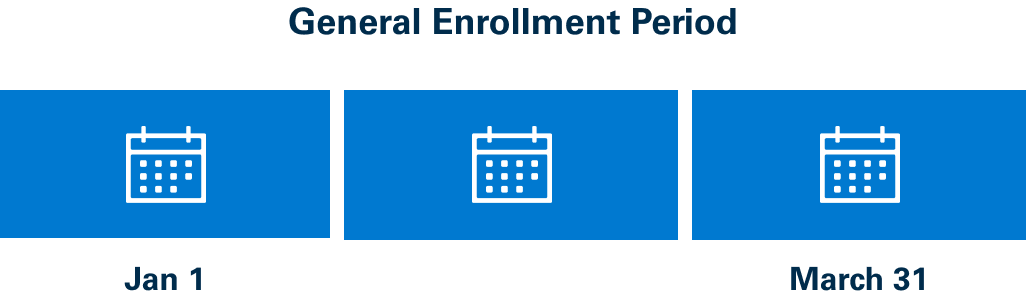
Plus, you'll usually have to wait until the next signup window (January through March) to get covered.
If you’re still working and covered by group health insurance when you turn 65, you won’t face a late enrollment fee.
FEP will typically remain your primary coverage.
Once you retire, you’ll have 8 months to enroll in Part B before the penalty kicks in.
To learn more, visit medicare.gov
If your spouse is still working and covers you on their group health insurance, you don’t have to enroll in Medicare Part B.
Your spouse’s active job coverage remains your primary plan. If that coverage isn’t through FEHB or PSHB, be sure to keep your own FEHB or PSHB coverage. If you cancel it, you may not be able to get it back later.
If you’re both retired, we recommend enrolling in Part B as soon as you’re eligible.
Don’t lose your coverage
Your coverage will remain active in retirement unless you cancel it. If you do, you cannot re-enroll in a FEHB or PSHB plan.
If you want to explore options like Medicare Advantage or TRICARE, pause your coverage instead of canceling it so you can re-enroll later. Learn more at opm.gov/retire.
You are past your initial enrollment period
You are past your initial enrollment period
If you're already receiving social security benefits:
If you started receiving Social Security benefits at least 4 months before you turned 65, you may have automatically been enrolled in Medicare Part A and Part B.
If you started receiving Social Security benefits for less than 4 months before turning 65, you may have automatically been enrolled in Part A. You will need to enroll in Part B.
To learn more, visit medicare.gov.
If you're still working:
As long as you are still actively working, FEP will be your primary coverage and Medicare late enrollment penalties will not apply.
Once you retire, you’ll have 8 months to enroll in Medicare Part B before the penalty kicks in.
A closer look at combining Medicare and FEP
Learn how to maximize your health coverage in retirement by having both Medicare and an FEP plan.
Explore Benefits